Friday, June 30, 2006

Re-arrest in front of the detention camp


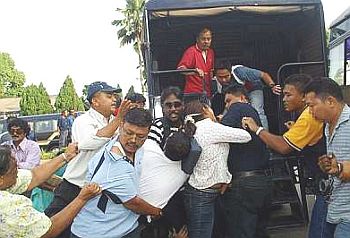
15 detainees have obtained their habeas corpus orders. Their lawyers served the court order to the officer in charge of Simpang Renggam detention camp. The detainees would have to be set free accordingly. There was heavy presence of police in front of the detention camp. Things turned chaotic and 8 of detainees were re-arrested.

It is the history repeats itself.

A few months ago, Tee Yam obtained the habeas corpus order. He wanted to leave the camp but worried that the police with re-arrested him. His lawyer sent the notice to the media. The reporters waited outside the camp for two days. Tee Yam had a short-live freedom before rearrested by the police. His lawyer threatened to file a contempt of court suit against Inspector General of Police. Within a few days, the Police released him.

The same episode happened to Karpal Singh in 1989. He walked out from Kamunting Detention camp after successfully obtained the habeas corpus order. While he was on the way back to his home in Penang island, the police re-arrested him in Nibong Tebal.

Abdul Ghani Haroon can be considered an exception. In the case of Abdul Ghani Haroon (2001), Hishamuddin J invoked S25(2) of the Courts of Judicature Act 1964 read with para 1 of the Schedule to make a further order that the police be restrained from rearresting the applicants at least for a period of 24 hours.

His Lordship wrote: "The purpose of the order, argued counsel, is not only to give fruits to my judgment earlier in the morning but also on humanitarian grounds since the families of the applicants were then still outstation and were on their way from Penang and Kedah to Shah Alam to meet the applicants."

In short, the re-arrest episode which happened outside Simpang Renggam camp was a grave injustice. Police has made a mockery to the habeas corpus order issued by the High Court.

Wednesday, June 28, 2006

Proposed amendment to Legal Profession Act

YB Chow Kon Yeow blogged from the Parliament house that the amendment bill for Legal Profession Act was tabled for first reading.

I have received a soft copy of the bill in national language. Drop me a mail honwai_wong@yahoo.com in you want to have the soft copy.

For the CLP candidates who are going to sit for the exam in July 2006, you don't have to worry about this. Having said that, if you have to resit for Professional Practice in October, you will have to know the amendment especially on the disciplinary proceeding part.

As I used to comment, the questions for the exam papers may be the same. The answers will differ.

The salient points:

1. Fasal 7 bertujuan untuk meminda subseksyen 13(4) Akta 166 untuk memendekkan tempoh seseorang pegawai mesti berkhidmat dengan Perkhidmatan Kehakiman dan Perundangan, iaitu daripada tujuh tahun kepada sekurang-kurangnya setahun, bagi melayakkan diri untuk mendapatkan pengecualian daripada menjalani apa-apa tempoh latihan bagi maksud penerimaan masuknya sebagai seorang peguam bela dan peguam cara.

My comment: The purpose is to make the Judicial and Legal Service more attractive to the law graduates.

2. Fasal 10 bertujuan untuk memotong perenggan 46A(1 )faj Akta 166. Dengan pindaan yang dicadangkan, kehendak bahawa seseorang mesti merupakan atau telah menjadi seorang peguam bela dan peguam cara selama tempoh tidak kurang daripada tujuh tahun bagi melayakkannya menjadi ahli Majlis Peguam atau sesuatu Jawatankuasa Peguam, atau ahli mana-mana Jawatankuasa Majlis Peguam atau mana-mana Jawatankuasa Peguam, dihapuskan.

My comment: This will effectively abolish the discrimination clause against young lawyers.
With this amendment, young lawyers are qualified to run for office of the Malaysian Bar.

3. Fasal 11 bertujuan untuk meminda seksyen 64 Akta 166 untuk memperhalus dan menjelaskan peruntukan yang berhubungan dengan pengadaan sesuatu mesyuarat agung tahunan, antara lain mengenai kehendak kuorum, iaitu lima ratus ahli Bar Malaysia;

My comment: This is welcome. The quorum requirement is changed from 1/5 of the total members to 500 members. Currently, there are 12,000 lawyers in Peninusular Malaysia. It is a high hurdle to cross the 1/5 quorom (2400).

4. Fasal 19 bertujuan untuk meminda seksyen 93 Akta 166. Antara lain, subseksyen baru (4D) menyatakan dengan khusus bahawa tiada perbuatan atau prosiding Lembaga Tatatertib boleh menjadi tidak sah semata-mata kerana Yang Dipertua Bar Malaysia atau wakilnya telah mengambil bahagian dalam penimbangtelitian Lembaga Tatatertib yang Majlis Peguam merupakan pengadu.

My comment: There is to close the gap. High Court has in a few cases nullified the decision of the Disciplinary Board due to the fact that the Chairman of the Malaysian Bar sat in during the disciplinary hearing in which Malaysian Bar is the complainant.

Updated: YB Karpal Singh raised objection to a new sub-clause on the Disciplinary Board of the Bar Council . His argument is on the conflict of interest and violation of the rule of natural justice.

The sub-clause says: No act or proceedings of the Disciplinary Board shall be invalidated solely on the ground that the President of the Malaysian Bar or his representative has taken part in any deliberation or decision of the Disciplinary Board relating to any complaint where the Bar Council is the complainant.”

His contention is that "no man shall be a judge in his cause".

YB Chow reported from his blog that a notice of amendment was tabled by Government to strike out the said sub-clause from the Bill.

The case in point is Ngeow Yin Ngee v Majlis Peguam Malaysia [2004] 3 AMR 476.

5. Seksyen 103B yang baru memperkenalkan sistem satu peringkat dalam penyiasatan apa-apa aduan terhadap seseorang peguam bela dan peguam cara yang hendaklah Rang Undang-Undang dijalankan oleh Jawatankuasa Tatatertib sahaja.

My comment: The Investigation Panel will become the history.

Anyway, there is no amendment to S46A. Office bearers of the political parties and trade unions as well as SAs and MPs are not allowed to run for office in the Malaysian Bar.
Friday, June 23, 2006

On aggravated rape and sentencing

The proposed amendment on the Penal Code and Criminal Procedure Code will be tabled in the Parliament for second reading soon.

The Criminal Law committe of Bar Council led by senior lawyer, Sithambaran, has opposed to the new definition on aggravated rape. Click here for the news report.

Teresa Kok. the DAP MP for Seputeh, who is also a member of the Select Committee expressed disappointment with the comment by the Bar Council. Please click here for her full statement.

I have written this back in year 2004 (in National Language). My view is that Parliament should only define the maximum sentence and leave the discretion for sentencing to the judiciary. Sentencing should be the disretion of the judge who has the opportunity to hear the evidence.

"Terdapat pihak yang mengkritik bahawa undang-undang rogol di Malaysia tidak mempunyai unsur keruncingan seperti Kanun Keseksaan India. Kanun Keseksaan India misalnya mempunyai hukuman spesifik terhadap rogol berkumpulan, rogol terhadap wanita hamil, pesalah ialah polis atau pegawai awam,

Pada pendapat saya, kategori di bawah Kanun Keseksaan India bukanlah satu senarai lengkap yang tertutup. Faktor keruncingan seperti pesalah yang mengetahui dirinya menjangkiti AIDS atau penyakit berjangkit seks misalnya tidak dalam senarai keruncingan Kanun Keseksaan India.

Parlimen biasanya menggariskan hukuman penjara maksimum dan hukuman sebatan maksimum, adalah menjadi budi-bicara mahkamah untuk menilai setiap unsur keruncingan dan menjatuhkan hukuman yang setimpal. Pada pandangan saya, budibicara kehakiman dalam menjatuhkan tempoh hukuman yang berpatutan tidak harus dikongkong oleh Parlimen. "

For the full text of my essay, please click here.

There are other online comments on this issue:

1. From the blogger Weng Tchung -"The Proposed Provisions on Aggravated Rape: Sithambaram Has Got it all Wrong"

2. Forum in the Malaysian Bar Website- Should there be a new category of rape?

3. Other NGOs as posted in the Teresa's blog.

Monday, June 19, 2006

Tax law

I have a new assignment. I have to complete an essay on the tax law to be submitted by 31 July.

The title is "Akta Cukai Pendapatan: siapa dapat dia dicukai. Bincangkan". It is one of the three essay topics set by the Bar Council for the 2006 Essay Competition. For details, please click here. The other topics are on intellectual property and arbitration.

The topics are quite challenging. It is for the post-graduate level.

For the next few weeks, I would read up on the recent development on tax law such as double taxation. I will blog it then.

Taming the Global Finance

I just finished reading the book "Taming Global Financial Flows : Challenges and Alternatives in the Era of Globalization" by Kavaljit Singh.

From my interpretation, the author is a leftish. He advocated for certain degree of capital control and also the implementation of the Tobin Tax.

He is an economist base in India.

This book serves as a basic text on the herd effect, assymetry information, hot money, money laundering, off-shore financial center etc.

For those who will like to make sense of what happening in the globalised world, there are two books I recommend:
- The World is Flat on the movement of human resource and
- Taming the Global Finance on the movement of capital.

Wednesday, June 07, 2006

On leave for two weeks -- come back after June 19th

I will stop blogging for two weeks. Will be back after June 19th.

Possible reason:
(a) Tight work schedule
(b) World Cup fever
(c) Big boss is visiting
(d) computer broke down
(e) all of the above.

Friday, June 02, 2006

Chambering: A small step in the journey of thousand miles

It is a good beginning for the month of June. On 1 June 2006 at 7pm, I have secured a chambering opportunity with a senior litigation lawyer in Georgetown, Penang. My tentative start date is middle of September which is 100 days from now.

Drop me a private email (honwai_wong@yahoo.com) if you want to know in further details.

Wednesday, May 31, 2006

Another gruesome murder trial

Singapore High Court released the judgment of PP v Aguilar Guen Garlejo on May 29, 2006.

There are a few similarities between the case of PP v Aguilar Guen Garlejo and PP v Leong Siew Chor (I have blogged this earlier).

1. Both cases happened in Singapore in year 2005. (September 2005 and June 2005)
2. The accused dismembered the deceased's body.
3. The deceased are foreigners. (Phillipines and PRC)
4. Public transport was used to transport the decease's body parts. (MRT and cab)
5. The body parts were thrown to reservoir or river.

Part of the judgment of PP v Aguilar Guen Garlejo:

"The accused then headed back to the Sunglade apartment where she systematically dismembered the deceased’s body and placed the body parts into a bag and a suitcase. The accused asserts all this was done while she was in a state of bewilderment. Her mind was still numb and whirling with shock that she had killed her best friend.
.....
On the following day, she took a taxi to Orchard Road and placed the bag containing the deceased’s head near the Orchard Road MRT station. Later she proceeded to MacRitchie Reservoir where she placed the suitcase near a public footpath within clear view, making no effort to conceal it. The accused cannot explain why she did this."


Is this a mere coincidence or copycat act? This should be an interesting research topic for the criminologist.

Chief Justice of Singapore, in his speech to the new lawyers, reminded them about the relationship between law and life. I found it very inspiring.

"The practice of the law is a great learning and a teaching life experience. You will learn more law and more about the law as you progress in your profession. The experience that you acquire from your interactions with your clients will teach you many lessons about life that you will not find in many other professions. Become a criminal lawyer, and you will see the darker and seamier side of life and learn of its harsh realities. Become a corporate lawyer, and you will see the profit-orientated and business-minded world, and learn of the human motivations that are driven by a materialistic life. Become a family law lawyer, and you will see the social problems of failed or dysfunctional families, and a side of life you have never seen before. Then, you may begin to understand and have more compassion for those who are less fortunate and the problems they endure.

Then, you may begin to appreciate all the social and other problems of society, as has been said often, from the womb to the tomb. In a modern society governed by the law, if there is a desire to help people to cope with their lives, the law is a good career choice for you. "

Tuesday, May 30, 2006

Amendment to Election Law


Bernama reported on May 10, 2006 that the amendment to election regulation was effective for the Sarawak State Election.

The full text of amendment is available at the SPR's website.

The salient points:
1. In addition to legal tender (meaning: notes/gold coins), the Election Commission is now accepting bank draft.

2. All counting and recounting is going to happen in the individual polling station. The margin for the request of recount has increased from 2% to 4%.

3. The practice of writing of the serial number of the voter on the counterfoil of the ballot is discontinued.

Monday, May 29, 2006

IPCMC (Malaysia) and ICAC (Hong Kong)

I was reading Jeff Ooi's blog on the resistance put up by the Royal Malaysia Police on the formation of IPCMC. There are striking similarities with the resistance by Hong Kong Police Force during the formative year of ICAC.

When established in 1974, the Hong Kong ICAC's main target was syndicated corruption in government departments - notably the Police Force.

News reports about police officers being arrested or investigated for corruption were almost a weekly occurrence in the first three years of the ICAC.

As recorded by the book "History of ICAC" (I have blogged this earlier):

"On 28 October 1977, about 2,000 people demonstrated at the police headquarters, while several dozen police officers stormed the ICAC Headquarters. After careful consideration of the circumstances, the Government decided to issue a "partial amnesty". "

The full text of the Partial Amnesty
The directive stated essentially that in future the ICAC would not act on complaints or evidence relating to offences committed before 1 January 1977. The exception would be those where suspects had already been interviewed (and allegations of offence put to them), persons against whom arrest warrants had been issued, and persons outside Hong Kong on 15 November 1977.Also excluded from the amnesty were offences considered so heinous that it would be unthinkable to refrain from action. However, it was stipulated that the governor should be consulted first.

The difference between the two is that IPCMC is a still-born. The Abdullah administration lacks the political will to bring the reform to the police forces.